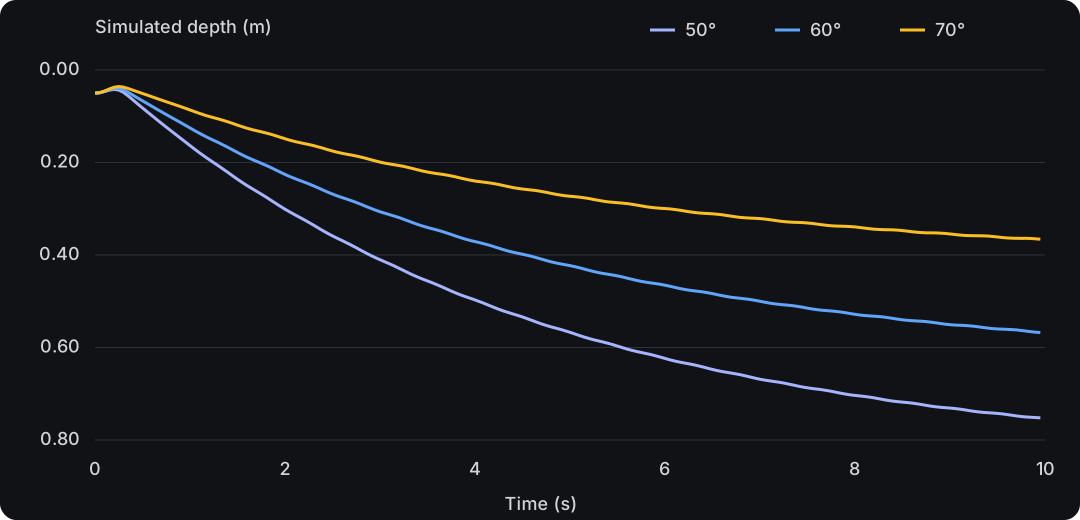
This public case compares one square-bill crankbait at three bill-angle inputs: 50°, 60° and 70°. Under the same tank settings, the lower-angle version ran deeper in the numerical model. The files below contain the inputs and actual simulation output; no physical water test is claimed.
The setup
Starting preset: square-bill crankbait. Body: 60 × 24 × 17 mm. Bill: 11 × 15 × 1.0 mm, square FR-4. Shell: hollow ASA, 1.2 mm walls with 0.15 mm modeled epoxy coating. Ballast, hooks, rings, line tie and print settings were left at the same preset values. Angles are measured downward from the body’s forward axis.
Tank scenario, steady 0.6 m/s tow, 3 m towline, 0.30 mm monofilament, water density 998 kg/m³, kinematic viscosity 0.000001 m²/s and zero current. Every run uses 20 substeps per 1/60 s frame (1/1200 s steps). Runs last 10 s; summaries use seconds 6–10.
Simulation results
| Bill angle | As-built mass (g) | Mean depth (m) | Wobble (Hz) | Wobble p-p (°) | Roll p-p (°) |
|---|---|---|---|---|---|
| 50° | 11.695 | 0.698 | 3.66 | 12.00 | 30.57 |
| 60° | 11.502 | 0.524 | 3.66 | 12.55 | 28.93 |
| 70° | 11.304 | 0.338 | 3.64 | 11.29 | 32.79 |
Mean depth, wobble and roll summarize the final four seconds, not the full start-up trajectory. The engine analyzes 120 Hz telemetry; the downloadable chart samples are decimated to 20 Hz. All three runs completed without a numerical reset.
Inspect the models and run the simulation
Each link opens an independent read-only snapshot with the matching simulation and print settings. Viewing the model and swimming action does not require sign-in. To edit a copy, sign in and copy it to your device or My designs.
What changed—and what did not
The 50° version had the largest mean depth in this comparison. Wobble frequency stayed near 3.64–3.66 Hz, while yaw and roll amplitudes were not monotonic. Do not turn these three results into a universal “best angle” recommendation. The tank towline also constrains depth, so these are not maximum cast-diving depths.
Only the angle input was edited, but each design was rebuilt through the as-built print pipeline. Bill angle changes the lip and tab geometry, mass and center of mass; finished-model mass therefore differs between runs. This is a complete-design comparison, not a test that isolates angle from every other physical consequence.
Inputs, data and provenance
Experiment crankbait-bill-angle-v1 was generated on October 31, 2026 with MakeMyLure application version 0.1.0. The JSON includes every design, simulation and print input, the final-window metrics, a physics-source SHA-256 fingerprint and the published telemetry samples. CSV values retain six decimal places where available; the display table is rounded for reading.
The source fingerprint identifies the core, geometry, mass, simulation and manufacturing TypeScript used to generate these values. Later software versions can produce different results; compare the same version, inputs, reset state and analysis window before drawing a conclusion.
This is an original numerical experiment using a bundled preset. It is not a customer testimonial, a manufactured prototype, a physical tank test, or evidence of catch performance. No such results have been added to this case.