This square-bill example compares one 4.5, 5.5 or 6.5 mm tungsten-alloy ballast ball in the same design. Larger balls reduce the estimated upward buoyancy margin; all three variants remain in the model’s floating class. These are fully submerged static mass calculations, not measured float tests or swimming simulations.
The same body and print setup
Starting preset: crank_square. Body: 60 × 24 × 17 mm; square FR-4 bill: 11 × 15 × 1.0 mm at 70°. The hollow ASA shell has 1.2 mm walls and a modeled 0.15 mm epoxy coat. Each variant keeps two 4 mm steel rattle balls, two size 6 treble hooks with size 2 rings, and the same attachment settings.
The single ballast ball uses the TUNGSTEN material model at station 19 mm from the nose toward the tail, with requested height fraction −1. Only its diameter input changes. The print setup uses split halves, 0.25 mm clearance, alignment pins, a 1 mm through-wire and 0.16 mm layer height.
How the calculation was made
Each variant was rebuilt through render geometry, the design mass model and generated print parts, then read from the corrected as-built model. Water density is 998 kg/m³ and gravitational acceleration is 9.81 m/s². No time integration or swimming run is part of this experiment, so there is no simulation duration or analysis window.
Calculated mass and fully submerged buoyancy
| Ball diameter (mm) | Ball mass (g) | As-built mass (g) | Displaced volume (mL) | Net buoyancy (g equivalent) | Model class |
|---|---|---|---|---|---|
| 4.5 | 0.859 | 10.564 | 13.273 | +2.682 | Floating |
| 5.5 | 1.568 | 11.304 | 13.273 | +1.942 | Floating |
| 6.5 | 2.588 | 12.358 | 13.273 | +0.888 | Floating |
Net buoyancy is buoyancy minus weight when fully submerged, expressed here as a gram-force equivalent. Positive values indicate an upward tendency. Every variant displaces 13.273 mL, equivalent to 13.246 g of this water; the unchanged exterior explains the equal displacement. Display values are rounded to three decimal places, with greater precision in the downloads.
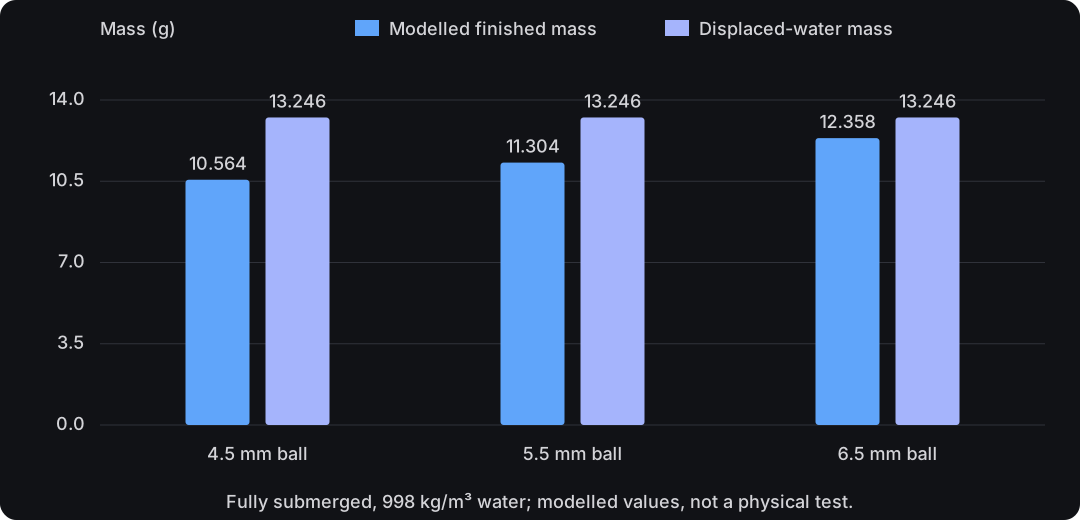
Why the finished-mass change exceeds the ball-mass change
The larger ballast ball also rebuilds its printed seat and related structure. The correction from design-only mass to as-built mass is 0.977, 1.008 and 1.041 g for the 4.5, 5.5 and 6.5 mm variants. Do not attribute every change in total mass to the tungsten-alloy ball alone. This compares complete generated designs, not isolated ballast masses.
All three net values exceed the software’s +0.5 g floating threshold. The comparison therefore does not demonstrate a floating-to-sinking transition or find an ideal ballast diameter. The class is a model label, not a measured rise rate or guarantee of rest attitude.
Inspect a matching model
Each snapshot carries the corresponding design and print options. You can inspect it without signing in; sign in and copy it before making changes. The snapshots also include consistent swimming-demo settings for exploration, but no swimming results from those settings are claimed in this static experiment.
Inputs, results and provenance
Experiment crankbait-ballast-v1 was generated on November 1, 2026 with application version 0.1.0. The JSON records each design, print options, mass breakdown, displaced volume, centers of mass and buoyancy, fit diagnostics, model classifications and snapshot links. It also includes computational-source and generator SHA-256 fingerprints, which identify files rather than independent certification.
The CSV contains one calculated summary row per variant, not a time series or physical test record. Centers use the body frame: nose origin, +x forward, +y left and +z up, reported in millimeters. A negative x coordinate lies behind the nose. Preserve the same inputs, print options and source version when reproducing the calculation.
What still needs a physical prototype
No lure was printed, weighed or water-tested for this case. Nominal material density, modeled coating and hardware can differ from a finished build; leakage changes buoyancy. This calculation does not determine the exact waterline, rise or sink speed, swimming action, maximum diving depth, strength or catch performance. Check fit and sealing, weigh the assembly and run a recorded float test before relying on a prototype.